















Rapidly evolving from an emerging technology to an essential part of business, Artificial Intelligence (AI) is increasingly available to bakery manufacturers of all sizes.
But while leaders are exploring how to use it for efficiency and productivity gains, many may still be unsure how to use it effectively.
The AI conversation often focuses on customer service and administrative tasks, but one of the most valuable applications for energy-intensive industries lies in energy management, highlights Andrew Curry, head of client services at consulting firm Trident Utilities.
Here he details how AI is creating opportunities for bakery suppliers, including helping better understand, control, and optimise energy use across operations.

”Traditionally, energy management was a reactive task. Reviewing invoices or interrogating spreadsheets to analyse energy consumption and identify patterns or anomalies. But the volume of data generated by modern manufacturing, combined with AI’s ability to scrape and digest vast quantities of information, means we now have an opportunity to be far more proactive.
With many bakeries on half-hourly energy meter reads across multiple production lines and facilities, what would have been a manual, time-consuming task can now be analysed quickly. This can be used to detect anomalies, benchmark performance, and identify possible inefficiencies and opportunities for cost savings.
One of AI’s greatest strengths, apart from speed, is its ability to bring together different forms of data. Rather than just analysing energy consumption in one area or line, combining that data with the number of staff on shift, production schedules and room use and dimensions, for example, helps create a full operational picture.
This joined-up approach enables business leaders to better understand the relationship between operational activity and energy demand. Is a manufacturing line only in use from midday, with full energy consumption starting at 9am when staff arrive on site and switch everything on? Or is the air conditioning on in an unoccupied room? Understanding these data patterns helps businesses make more informed operational decisions, improving energy efficiency without compromising production.

A closer eye on consumption
Digitalisation and the use of AI-driven tools are also transforming the way manufacturers monitor energy use. They grant immediate access to consumption and cost data instead of waiting for monthly reports or bills, and can also be used to trigger real-time alerts when unusual energy spikes occur.
This allows issues such as potential faulty machinery or equipment left running unnecessarily to be investigated and resolved quickly. For bakeries operating continuous refrigeration and production equipment, even small spikes can significantly impact overall energy costs over time.
Alongside supporting daily efficiencies, AI is a valuable tool in forecasting and longer-term decarbonisation strategies. Through historic data analysis and predictive modelling, manufacturers can accurately predict future energy consumption, helping with expenditure and budgeting. This is particularly helpful for businesses trying to meet high-growth strategies and expand across multiple sites. AI can overlay energy consumption with sales figures, staffing costs, and other revenue to assess the viability of expansion investments. Businesses can also model how operational changes to meet market demand may affect costs and carbon impact.
Anything that reduces unnecessary energy consumption and improves resource efficiency can support wider sustainability goals. Smarter energy management plays a huge part in that and is often a more tangible way to decarbonise, delivering quick, visible results. While energy markets remain volatile, access to AI-driven energy data is supporting manufacturers in financial planning, procurement, net-zero, and growth strategies.
Importantly, while some consider AI a threat to jobs, it shouldn’t be viewed as a replacement for people. It works best as a support tool, used by skilled employees to process large quantities of data quickly and easily, producing outputs that help businesses thrive.

Case study
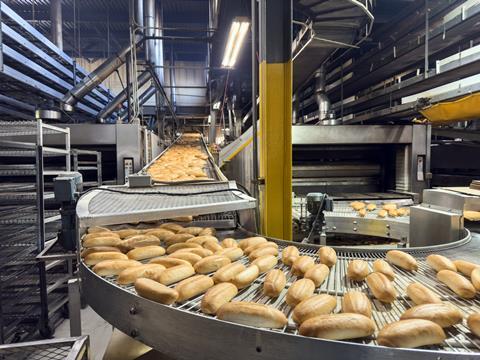
AI is already delivering tangible results at manufacturers. For example, Slough-based Montana Bakery – part of Martin Braun-Gruppe and producer of chilled and frozen premium-topped breads – is using our in-house Pulse system to manage energy use.
Montana’s head of facilities, Michael Phillips, said: “In the past it was hard to predict our energy consumption and ultimately, we didn’t have the raw data available to determine our costs. Sometimes we were using historical data that didn’t provide the information we needed to make key business decisions.
“Now, using this system, we can produce pinpoint forecasts that enable us to optimise specific usage areas as production increases. In addition, with the forecasting tool, we now have full visibility into the cost per unit for production, which is highly valuable information in a fast-moving business such as ours.
“We know what our energy costs are going to be, meaning we can flex production when needed and respond to additional demands when relevant without the guesswork. It has been a game changer for us,” added Phillips.
In some respects, despite AI having been around for at least two decades, it’s also relatively early days for the technology and for what its future potential might be. But what is clear is that AI is already an essential part of modern energy management strategies and a key player in energy-intensive industries like baking becoming smarter and more efficient.”












No comments yet